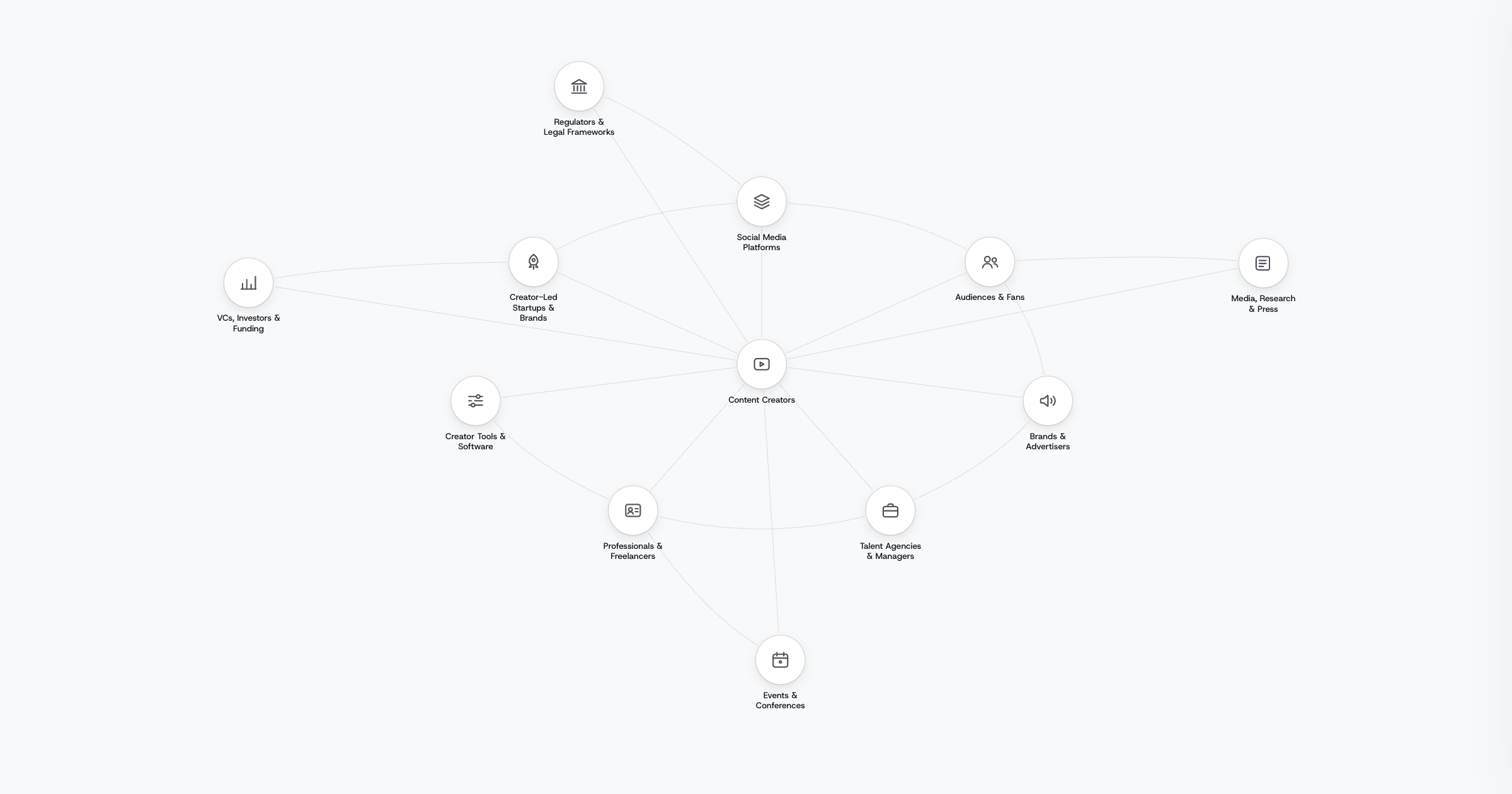
The 2026 creator economy ecosystem map: who does what, and who pays whom
The creator economy is a web of people and businesses connected by content, attention, money and rules. I grouped them into 12 stakeholders. Follow one relationship and you understand a business model; follow a few and you see who depends on whom.

What the map shows
The reading view lists all 12 stakeholders and 102 relationships, each with a direction. One company can play several roles: a creator who sells software acts as a creator and as a software vendor at the same time. The categories describe roles, not fixed boxes.
The tools, brands and platforms Dives show the real companies behind each role. They are curated by me, so they are big but not complete. The methodology explains what is in and what is left out.
The 12 stakeholders
Here is how I think about each role. Every business uses its own terms and prices; these are the patterns I keep seeing.
Content creators
They make the work and own the relationship with the audience. Money comes from ads, sponsors, memberships, products and services, usually several at once. Most of them earn far less than the headlines suggest, which is why I'd follow two things first: who controls their distribution, and how much their audience trusts them.
Audiences and fans
They decide what deserves their time, and sometimes their money. Fans pay for access, products and experiences; everyone else supplies the attention advertisers pay to reach. People treat audiences as a number. I think they are the most powerful group on the map.
Social media platforms
They distribute the work, recommend it and write the rules. Ads and paid features fund them. A payout is a contract the platform can change, not a reward for posting, and they do change it: YouTube is doubling the bar to join its Partner Program from 2027.
Brands and advertisers
They pay for an audience, for production skills, or for the right to reuse creator content in their own ads. The good partnerships I have seen get the audience fit right first and the paperwork second. Watch the middlemen too: agency fees are now a real transparency question.
Talent agencies and managers
They represent creators, negotiate deals and open doors, usually for a commission. In 2026 they are also buying and building companies with their clients, which makes representation and ownership harder to tell apart.
Creator tools and software
My favourite part of the map. Tools sell the means to make, publish, measure and charge for the work, mostly through subscriptions and transaction fees. They live or die by whether creators keep paying, and by platform policy they do not control.
Professionals and freelancers
Editors, designers, strategists, lawyers and operators do the work behind a creator business, by the project or on retainer. This is the most underrated group in my opinion, and the easiest way into the industry if you do not want to be on camera.
Creator-led startups and brands
An audience turned into a company with products, staff and costs. Distribution is the easy part for a creator. Fulfilment, margins and repeat customers are where these businesses are actually tested.
See creator-led startups and brands and their relationships.
VCs, investors and funding
Capital in exchange for a share of future returns. It is financing, not revenue, and founders give up ownership and some control for it. In 2026 the money moved from venture rounds to buying businesses that already work.
Media, research and press
They explain the industry to itself and decide which companies get attention. Ads, subscriptions and research fund them, often paid for by the companies they cover. I count myself in this group, so read me with that in mind.
Events and conferences
Where everyone meets in person to learn and do deals, funded by tickets, sponsors and exhibitors. The centre of gravity has moved toward advertising festivals: VidCon is becoming part of Cannes Lions.
Regulators and legal frameworks
They set and enforce the rules on advertising, data, children and consumer protection. They are not a revenue stream, which is exactly why they get overlooked. A platform policy and a law are different kinds of rule, but both can end a business model overnight.
See regulators and legal frameworks and their relationships.
The four flows
How money moves
A sponsor pays a creator for a campaign. The creator then pays an editor, a manager and a few software subscriptions. Follow the money relationships to separate what a business earns from what it spends and what it raises.
How content and attention move
A creator publishes on a platform, and an audience watches and reacts. Content goes out, attention comes back. The content and attention lens shows that loop on its own.
Who sets the rules
Platforms change their terms whenever they like. Regulators set legal requirements on top. The FTC's guidance, for example, says creators must make a material connection to a brand obvious. FTC, November 2019; checked October 21, 2026. The rules and influence lens shows who shapes whom.
Who provides the services
One editor, manager or producer often works for several creators at once. These relationships show how much work sits behind one visible channel. Explore people and services.
What changed in 2026
Agency fees became the next transparency fight. ANA figures put the average agency take at about 30% of influencer spend, and only 39% of agreements are transparent to the marketer. Digiday, October 2, 2026.
At Made on YouTube, YouTube announced help for creators answering brand briefs, wider likeness detection for faces and voices, and real-time dubbing for live streams. Google, September 23, 2026.
VidCon is leaving Anaheim, its home since 2012, to become part of Cannes Lions as VidCon x Lions Creators. Tubefilter, September 17, 2026. The same day, Spotify expanded its Partner Program to more than 35 new markets. Spotify, September 17, 2026.
CreatorIQ's State of Creators survey found that 67% of respondents earned less than $10,000 a year from content creation. CreatorIQ, August 11, 2026.
Accenture closed its acquisition of the creator agency Whalar. Accenture, June 8, 2026; closing update July 31. It was one of a record 70 creator economy deals in the first half of the year, when media overtook software as the most-bought category. Net Influencer, July 7, 2026.
YouTube's annual CEO letter put shopping, brand partnerships and fan funding among its priorities. YouTube, January 21, 2026.
Each of these touches a different part of the map: platform access, creator earnings, agency ownership, events and money flows. It is my selection, not a full news feed. The 2026 overview has the numbers and what they do and do not measure.
How we built this map
Stakeholders are roles. Relationships are an exchange or a dependency between two of them. News items link to their sources. Where a circle sits and how long a line is mean nothing about revenue or importance, so please read the sources and method before quoting the picture as data.
Explore it interactively
Start with creators, follow a connection, and flip between the four lenses. Open List for the text version, or read the beginner's explanation. You can also download the full-resolution map image.